Results From YDNA-Based Analysis
© 2009 by James Michael Gossett and Jeffrey Lynn Gossett
All materials contained on this site are protected by United States copyright law and may not be reproduced, distributed, transmitted, displayed, published or broadcast without the prior written permission of the authors. However, you may download material for your personal, noncommercial use only.
Y-chromosomal DNA (YDNA) is passed from father to son, from son to grandson, from grandson to great-grandson, etc. -- usually unchanged in sequence. However, occasionally a random mutation occurs in the replication process when a son is produced, introducing a change in the YDNA sequence of nucleic-acid bases that this son will, in turn, pass along to his son. Tracking such changes in specific regions ("markers") of the YDNA is the basis of YDNA genealogical analysis. Only males possess the Y-chromosome; therefore, YDNA-based genealogical analysis is uniquely suited for surname studies, since sons generally inherit their fathers' surnames, along with their Y-chromosomes.
YDNA-marker analysis has the potential to address our two major objectives: (1) to determine the European origins of the Gossett families in America; and (2) to determine the interrelationships among them. Additionally, YDNA-marker analysis can assist individuals in getting past "roadblocks" in their genealogical research. Most of us have a genealogical "paper trail" we've established using traditional methods of genealogical research, and have run into some dead-end in that trail – a point in the past beyond which we haven't been able to go. Through comparative analysis of YDNA-marker changes, we might find participants of the same or closely related lines with whom we can compare notes. Perhaps our new-found "cousin" will have a dead-end much further back in time than our own. If not, we might at least develop useful leads for further research.
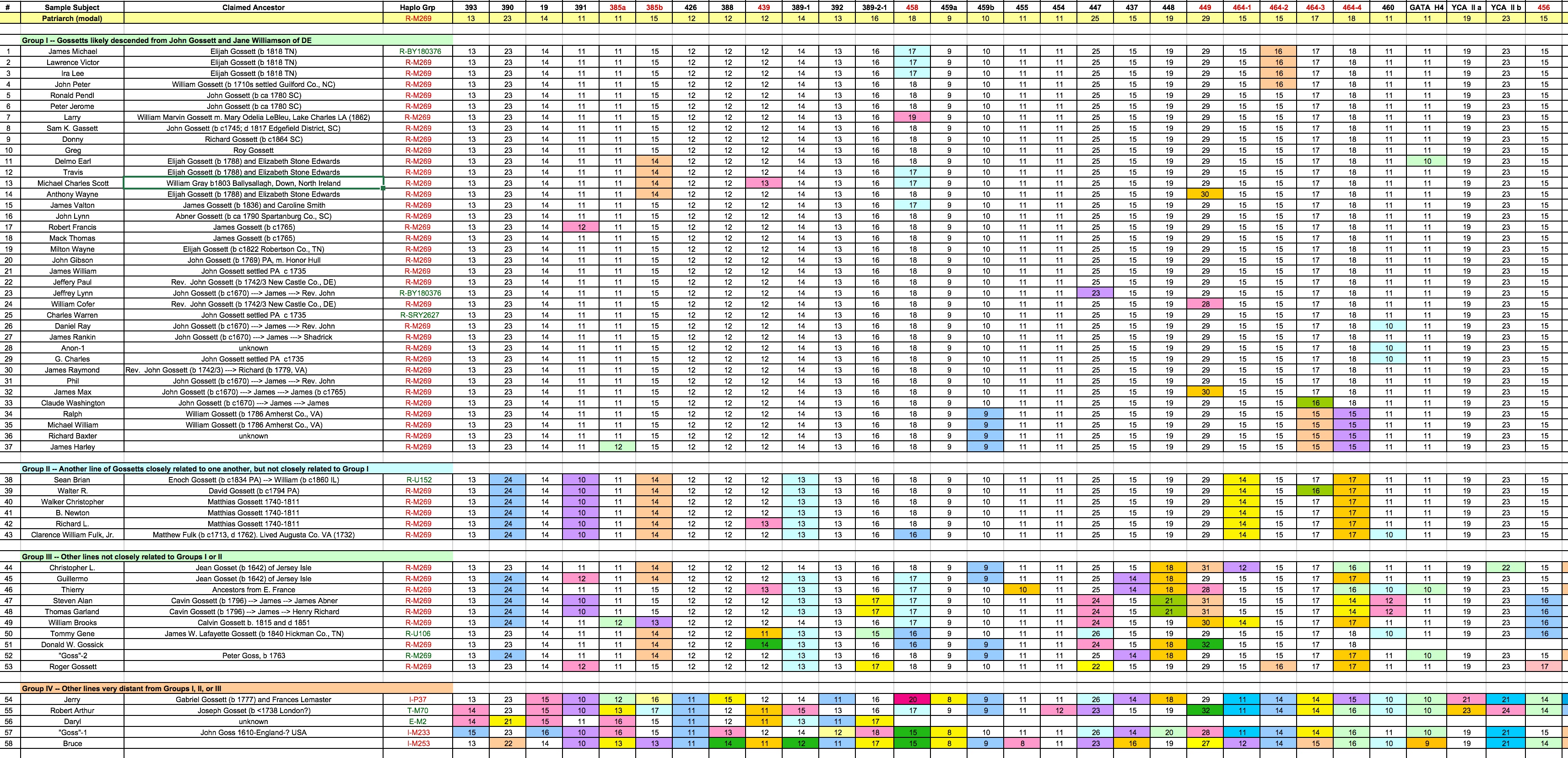
To date, we have 37 participants, most of whom have been tested to at least the 37-marker level. Results are shown in the following Table. Note that this Table is in Flash format. You can zoom the content by moving the slider next to the little box on the toolbar that shows the current % size. You can also click on the little box at the extreme right end of the toolbar and the Table will open in its own window -- still in Flash format. If Flash isn't convenient for you, click on either of the following two selection boxes for other alternatives:
Notes: In this Table, some multiple-copy markers have been renamed and reassigned, versus how FTDNA reports them. For example, the two locations of the double-copy marker CDY have been renamed CDY1 and CDY2, and given a Y-chromosome, location-specific meaning that subtly differs from the CDYa, CDYb terminology used by FTDNA. The same was done for the multiple-copy 464 marker (i.e., 464a,b,c,d have been renamed 464-1,2,3,4 and given location-specific meaning). This results in some re-assignment of data for a few participants. The issue is a complicated one -- interpreting results from multi-copy markers. For detailed explanation (not for the faint of heart!), click here. Also, we have redefined the 389-2 marker to be the difference between 389-2 and 389-1, and renamed it "389-2-1." The reason for this? Marker 389-1 is a marker whose sequence is wholly contained within 389-2. For example, suppose individual A has values of 14 and 30 for 389-1 and 389-2, respectively; and individual B has values of 13 and 29 for these same two markers. At first glance, it would appear these two individuals have a genetic difference of 2; however, this is misleading. The –1 change in 389-2 resulted from the –1 change in 389-1 -- it's not a separate mutation. It is easier to assess differences accurately if the second marker is redefined to include only the sequence of 389-2 that is not already included in 389-1. The convention we are using -- 389-2-1 in place of 389-2 -- while not used by FTDNA, is used by National Geographic's Genographic Project. Finally, we should note that one of our participants -- Timothy Joseph -- had his YDNA markers tested by ancestry.com, which uses some different markers than used by FTDNA (which explains the missing markers for him in the Table). In addition, ancestry.com computes values differently for some of the same markers used by FTDNA, necessitating a conversion of their values to FTDNA format. These conversions are reflected in the tabulated values above.
Note that the markers shown in red (385a,b; 439; 458; 449; 464-1,2,3,4; 456; 576; 570; and CDY1,2) are known to undergo mutation at a considerably higher frequency than do markers in black font. Where blanks appear in the Table, it indicates that results are not available.
Summary Analysis
Data analysis -- presented in detail below -- shows that participants fall into three groups:
Group I -- relatively closely related individuals who among them share a Most Recent Common Ancestor (MRCA) less than about 300-400 years ago. No member of this Group appears to be descended from Jean the Huguenot of Jersey Isle.
Group II -- individuals not closely related to Group I (nor to one another), but who at least share the R1b1b2 haplogroup. Since these individuals have the Gosset(t) surname and R1b1b2 haplogroup, they are undoubtedly related to one another and to Group I, but the MRCA is quite distant in time (at least 500-1200 years). Let's put it this way: Group II individuals are generally as far from one another as they are from anyone in Group I. Group II contains our two participants -- Christopher L. and Guillermo Gosset -- who have paper-trail lineages showing descent from Jean the Huguenot of Jersey Isle through a prominent great-great-grandson who lived in England in the first half of the 1800s. Unfortunately, YDNA results show the two are not closely related -- they cannot both be descended from Jean. Moreover, neither is within about 500 years of being related to any other member of any other Group. [Note: The closest relationship is between Guillermo and Sean Brian; however, there is only a 5% chance that their MRCA lived within the past 450 years.] If either Christopher or Guillermo is descended from Jean, then none of the rest of us can be.
Group III -- individuals very distant from Groups I or II, and who do not even share the R1b1b2 haplogroup. No two individuals in Group III are closely related to each other, nor to any individuals in the other groups. The time to MRCA (between individuals within the Group or between individuals in any other Group) is measured in the thousands of years.
The Details
The groupings can be qualitatively visualized by noting the relative numbers of colored squares in the Table within the three Groups -- a color is used whenever a marker differs from the most common or "modal" value (which is presumed to be the value of the "patriarch"). There are far fewer colored squares in Group I than in the other two Groups.
We can present results more quantitatively by invoking a statistical analysis, along with assumed average rates of marker changes, and an assumed number of years per generation (e.g., 30 years, as an average). We used the program, Y-Utility to compute how long ago was the MRCA of any two participants. [And note that we had to convert 389-2-1 marker values back to 389-2 values, to use the utility correctly.] Be aware that the results are heavily influenced by assumptions of marker-change rates. We used the FTDNA model for mutation rates (with infinite-allele assumption) to compute two Tables -- 50% and 5% probability estimates. Click on the selection boxes below to open each in a new window.
50% probability that MRCA of a pair was less than number of years ago indicated in Table.
5% probability that MRCA of a pair was less than number of years ago indicated in Table.
Bear in mind that the uncertainties in such calculations are large. The 50% probability Table provides a useful, rough idea of the time-frames to the MRCA between two individuals. From the color-codings you can easily discern the relative closeness of Group-I members, in comparison to those of the other two Groups. With a few scattered exceptions, pairs of Group-I members generally share MRCAs 100 to 400 years ago. However the MRCAs of pairings between Group-I and Group-II members are typically 800 to 1,800 years ago; and of pairings between Group-I and Group-III members, 3,000 to 7,000 years ago. Pairings within Group II show MRCAs of 1,000 to 1,800 years ago -- about the same as between Groups I and II -- meaning that Group II members are no closer to each other than any of them is to a Group-I member. [The lone exception is the pair, Steven Alan and Thomas Garland. However, we know from their paper-trails that they share a recent ancestor and hence represent the same line.]
We recommend the 5% probability Table for use as a reality check on what begins to be unreasonable. If an event has less than a 5% chance of being true, we generally reject its possible occurrence. We used the 5% probability Table to generate the time-to-most-recent-common-ancestor (TMRCA) conclusions in the Summary Analysis above. For example, if we are interested in TMRCA between James Michael and Christopher L., there is a 50% probability that their MRCA lived more recently than 1,050 years ago. Given the probabilistic nature of mutation, is it possible that these two individuals might share a MRCA much more recent than this? Yes, but a look at the 5% Table shows that there is only a 5% chance that their MRCA was within the last 600 years. We would thus conclude that their MRCA lived "more than 600 years ago." This means that any hypothesis that they share, as ancestor, Jean the Huguenot of Jersey Isle (b 1642 in Normandy -- roughly 300 years before the births of James Michael and Christopher) is very unlikely to be true.
Assessing the Claim of American Gossetts' Descent from Jean of Jersey
There is a long-held and oft-repeated myth that the Gossetts in America descend from Jean Gosset (b 1642), a Huguenot Norman noble who fled France for Jersey Isle in 1685 at the revocation of the Edict of Nantes. [The source of the story and its evidence are critically examined elsewhere on this site.] The Gossetts in America are claimed to descend from this Jean through two Gosset brothers -- Jean and Pierre, grandsons of Jean -- who are claimed to have emigrated from Jersey Isle to America in ca. 1730 and 1760. The first few generations of lineage from Jean (b 1642) are depicted here. What can the YDNA evidence tell us about the truth of this myth?
We located two living Gossets who -- on paper at least -- appear to descend from Jean of Jersey through descendants of Jean who remained in England for generations after the two brothers (Jean and Pierre) supposedly immigrated to America: (1) Christopher L. Gosset of the UK and (2) Guillermo Gosset-Lagarda of Mexico. [Christopher's lineage can be viewed here, and Guillermo's, here.] Both lineages pass through Jean's grandson Isaac (1713-1799), a prominent wax-modeler who had moved from Jersey Isle to London; and through Isaac's grandson Isaac Gosset (1782-1855), Vicar of Datchett and a Royal Chaplain. Isaac (b 1782), a great-great-grandson of Jean the Huguenot, is the claimed MRCA of Christopher and Guillermo; Christopher is four generations from Isaac and wife, Dorothea Sophia Banks Lind; Guillermo is five generations from them. Of the two modern descendants, Christopher L. appears to have the stronger, paper-trail evidence of descent from Jean the Huguenot -- stronger, mostly, because Christopher's ancestors remained in England where evidence is relatively easily obtained. [Go here for more information about the two lineages.]
Christopher and Guillermo were tested at the 37-marker level. While both are in haplogroup R1b1b2, results show that neither is closely related to anyone in our study. In fact, the two are not closely related to each other! According to the paper-trails, their MRCA is a mere 4.5 generations ago. However, their genetic distance is 14. With such genetic distance, there is less than a 0.1% chance that their MRCA is within 16 generations. Clearly, both cannot be descended from Jean of Jersey (b 1642). Is either? We cannot say, though Christopher's paper-lineage, in particular, is quite compelling.
Neither Christopher nor Guillermo is closely related to any Group-I member. The closest Group-I member is a genetic distance of 12 from Christopher and a genetic distance of 13 from Guillermo -- i.e., these two are as far from the rest of us as they are from each other. Jean of Jersey (b 1642) is typically 8 or 9 generations (and 300-350 years) from the birth of any present-day Gossett. With the sorts of genetic differences we see between Group-I members and either Christopher or Guillermo, the chance of our MRCA being within the past 9 generations is much less than 0.1% -- well outside the realm of reasonable possibility.
If either Christopher or Guillermo is descended from Jean of Jersey (b 1642), then it is highly improbable that any of the American Gossetts (thus tested) is descended from him.
Estimating the Year of Birth of the Group-I Patriarch
For Group-I individuals, who share a relatively recent MRCA, we can use the aggregate data in the Tables to refine an estimate of TMRCA for the patriarch of Group I. Superficially, it would seem all we need do is to average the number of years to the MRCA between each participant and the "modal" or patriarchal person. First, it needs to be recognized that these values would have to be multiplied by 2. [Click here for explanation.] If we do this, we get an average distance (± 95% confidence interval) of 337 ± 79 years to the patriarch of Group I [i.e., d.o.b of 1623 ( ± 79 years), if we use 1960 as an average d.o.b. for our participants]. Secondly, however, we need to recognize a fundamental flaw in this calculation: Namely, there is a correlation structure to the data -- i.e., many participants share a MRCA more recent than the patriarch and therefore their computed times to the patriarch are correlated to some extent. The clearcut example is James Michael and Lawrence Victor -- brothers who represent exactly the same lineage between patriarch and the present. Ideally, we would like to include in our calculation a representative sampling of the various lines descending from the patriarch, with not too much skew towards any one son of the patriarch, versus another.
Therefore, we chose nine members of Group I who do not appear highly correlated internally. For example, we included James Michael, but not Lawrence Victor or Ira Lee. Additionally, we selected members who represent a balance among the lines of descent: James Michael, John Peter, Peter Jerome, Delmo Earl, Robert Francis, Jeffery Paul, Jeffrey Lynn, Charles Warren, and James Rankin. Using these provides an estimated patriarchal d.o.b. of 1662 ± 114 years (i.e., between 1548 and 1776). [Click here for details.]
YDNA-Marker-Based Lineage Trees
Differences in YDNA markers can be used to establish a YDNA-marker-based lineage "tree" for Group I. For each marker, we assigned as starting or patriarchal value, the value evidenced by the majority of tested participants (i.e., the modal value) in the Group.
Note: Click HERE to open tree in a new window at larger size.
Though the assignment of "starting" marker values is somewhat arbitrary, assuming a different set of values would not change the relative relationships among the lineages.
You can see marker-changes in any line by following the path from patriarch to present individual. Thus, the lineage chart shows that James Michael's line has experienced changes in three markers (570, 464b and 458) in descending from patriarch to present, while Jeffrey Lynn's line has experienced change in only one marker (447) over this same time-span.
Note that the CDY markers tend to undergo change more readily perhaps than any other marker. Careful analysis of the data suggests that CDY1 has undergone five independent changes (in Ronald Pendl's line, in Ira Lee's line, in Charles Warren's line, in Ralph's line, and in James Rankin's line). The decrease in marker value from 38 to 37 (in Charles Warren's and James Rankin's lines) is obviously independent of the increase in marker value from 38 to 39 (in Ronald Pendl's, Ira Lee's, and Ralph's lines).
But how do we know that the three occurrences of +1 change in CDY1 were independent of one another? They must have been independent changes because there is no alternative way to reconcile other differences among Ronald Pendl's, Ira Lee's, and Ralph's lines. We have solid paper-trails from Ronald Pendl's, John Peter's, James Michael's, and Ira Lee's lines to show that Ira Lee and Ronald Pendl do not share a common ancestor less than 5 generations ago. Similarly, the many differences in other marker values between Ralph's line and the other two (Ronald Pendl's and Ira Lee's) make it difficult to draw any other conclusion.
How do we know that the two occurrences of –1 change in CDY1 were independent of each other? Couldn't we move the decrease in CDY1 in Charles Warren's line to a position above the change in his 413a marker, and then show James Rankin's line branching from Charles Warren's below the CDY1 marker-change (and above the relocated 413a change)? Yes, but it would then be almost impossible to reconcile the lineage of Charles Warren with the lineages of G. Charles and Anon-1, who share the 413a marker-change with Charles Warren, but not the CDY1 change. One would have to accept a double change in CDY1 for both G. Charles and Anon-1 (first a decrease of 1, and later an increase of 1) to account for this -- or independent changes in 413a for Charles Warren, G. Charles, and Anon-1. Since marker 413a is a "black-font" marker (i.e., one that doesn't have a great tendency to change), we are reluctant to assume two independent changes in it.
The CDY2 marker similarly shows three independent changes among our participants -- a change of –2 in Phil's line and a change of –1 in Claude Washington's and Donny's lines.
We have concluded that the CDY markers are very changeable and have exhibited several, independent changes in our participants' lineages -- meaning that these CDY1 and CDY2 markers are virtually useless to us in establishing relationships among our lineages. This reminds us that we must be careful in interpreting observed changes in markers that have a tendency towards frequent change in value. The larger the marker value (i.e., the larger the allele-length), the greater the tendency to change [click here for more details]. Our CDY markers have the largest allele-lengths (38 and 39, respectively) of any markers in our suite. We should not be surprised to find independent changes in CDY markers.
Similarly, the –1 changes in marker 458 (another "red," change-prone marker) experienced by James Michael's and James Valton's lines must be considered to have occurred independently of each other. There is no other, rational way to view the situation, given that James Valton's line does not share changes in markers 570 and 464b that are evident in James Michael's line -- and these two must precede (not follow) the change in 458 to make any sense of the rest of the tree (and of the paper trail).
In earlier versions of such charts, a "generations-ago" scale was included on the left. However – absent an accompanying paper-trail-based model – it doesn't make much sense to include such a scale. As discussed in the accompanying tutorial on estimating time to most recent common ancestor (TMRCA), the uncertainty in estimating TMRCA is rather large – especially when a relatively few generations are involved. You can get a feeling for this by noting that, in whatever number of generations actually has transpired from the patriarch to today, some lines have experienced no marker-change (e.g., James Raymond's), while others have experienced as many as four marker-changes (e.g., Ira Lee's). Therefore, whatever "average" number of generations is thought to occur between marker changes, the variance must be rather large to account for these differences. And there is no assumption of starting values that eliminates such discrepancy in marker-changes among the lines. Employing a different set of starting values merely rearranges the maldistribution of numbers of marker-changes among the lines.
It should be emphasized that the locations of branch points on the vertical scale are just educated guesses – you should not place too much credence in them without a paper-trail to overlay. Likewise, the vertical locations of the marker-changes are arbitrary. All we can know for sure is that the marker change must have occurred at – or later than – a branch-point. [For more on this issue, click here.]
One interesting and useful thing that can be done with YDNA-based lineage charts is to attempt their combination with knowledge from paper-trails or with hypothetical lineages. We hypothesize [with supporting arguments presented elsewhere on this site] that the Group-I Gossetts in America descend from John Gossett (b. ca. 1678) and Jane Williamson of Newcastle Co./DE. [Note that this d.o.b. agrees very well with the analysis presented above in which the patriarch's d.o.b. was estimated.] John of DE is known to have had at least three sons — John, James (or Jacob) and William. We additionally suggest that John of PA (the ancestor of Charles Warren) is the John who was son of John and Jane of DE. Furthermore, their son William (b. ca. 1710s) is likely the same William who settled in Guilford Co./NC. We can overlay this assumed lineage on the YDNA-based lineage:
Note: Click HERE to open tree in a new window at larger size.
In doing so, we have attempted agreement with the "generations" time-scale on the left. [Note: Because of the great difference in ages among our current project participants – some are old enough to be the grandfathers of others – and because years between generations differ among the different lines, we have arbitrarily declared ancestors born ca. 1780 to be of "generation 5" in the chart above. Thus, in some cases, a project participant might find some discrepancy between the generations-ago of a known ancestor and his appearance in the chart above.]
Note that placement of participants in the chart above has been guided by their YDNA results, but also considerably by their "paper-trails." Thus, although James Raymond and Mack Thomas both show identical YDNA results at the 37-marker level, we have shown them descended from different sons of James of SC (b c1718), in accordance with what they know of their ancestry from family records. This brings up an important point: Most of our participants on the right side of the chart show one or fewer marker-changes in descent from their presumed common ancestor [James of SC (b c1718)]. With so few changes, fine resolution of their lineages is not possible from YDNA analysis alone. We know they are all more closely related to one another than they are to participants appearing on the left side of the chart, but we cannot place them as descended from particular sons and grandsons of James based upon genetic analysis -- they're simply too similar with respect to YDNA markers.The YDNA results certainly suggest that Donny, Delmo Earl, Peter Jerome, Ronald Pendl, John Peter, JamesMichael/LawrenceVictor, and Ira Lee are more closely related to one another than to the other project participants (by virtue of the shared difference in marker 570 -- it essentially divides the tree in half). If, indeed, these participants on the left-hand side of the tree are descended from William of NC, then there remain questions that should be the focus of additional research: How do Elijah (b. 1788), John (b. 1780 SC), John (b. 1778 NC) and Elijah (b. 1818 TN) link into the descendency from William of NC? William of NC (b. c1710s) had many sons, who in turn had many more sons – do we really know enough about all of them?
John Lynn traces his lineage back to Abner (b. 1790 SC). In the model we have shown him to be descended from an unidentified brother of the Rev. John. We're unaware of a paper-trail that confirms this – therefore, it's yet another suggested area for research. We have depicted William (b. 1758), Shadrick (b. c1755), and James (b. c1760) to be brothers of the Rev. John (and all sons of James b. c1718) -- and indeed it is possible that Abner is one of their sons. The paper trail is not clear on the relationships among the Rev. John, William, Shadrick, and James -- though their geographical proximity suggests they might have been brothers. It is also possible that, through further investigation, some of the putative sons of the Rev. John might prove, instead, to be his nephews.
Some participants have wondered whether the above model is consistent with assumed rates of marker-change – i.e., could so many changes have occurred within 8 or 9 generations? Our best answer is that the YDNA data are not inconsistent with the above model, as should be evident if you examine the 5% probability Table presented here. Statisticians tend not to reject a hypothesis unless its probability of being correct is less than 5% (i.e., a 95% confidence in rejection). Ralph, the Group-I member with the greatest genetic distance from the rest, nonetheless has a 5% probability of a TMRCA less than 330 years when paired with Group-I members most distant from him-- a result that puts him within reach of John of New Castle County, DE.
Bottom line: Nothing in the YDNA data statistically demands that the model be rejected. And the evidence from conventional genealogical research, presented elsewhere on this site, makes the hypothesis convincing -- far more convincing than is the evidence for descent from Jean of Jersey Isle.
Stay tuned!